Duplex stainless steel gets its name from its unique microstructure.
For example, there are two different metal materials: one is soft and flexible like "plasticine", and the other is strong and sturdy like "hard wood".If the two are mixed evenly, the new material will have both "toughness and strength".
Definition of a phase:In metallic materials, a "phase" refers to a microscopic region with uniform composition, structure, and properties.
For example, ice and water are two different "phases" of water.
Two basic phases in stainless steelIn duplex stainless steel, there are two basic phases: austenite and ferrite.
The austenite phase has a face-centered cubic crystal structure, exhibiting excellent toughness and ductility, is non-magnetic, and offers excellent weldability and corrosion resistance.
The ferrite phase has a body-centered cubic structure, exhibiting high strength and hardness, magnetic properties, and strong resistance to chloride stress corrosion cracking.
The meaning of duplex stainless steel The name "duplex stainless steel" comes from its precise chemical composition control, such as adjusting the content of elements such as chromium, nickel, molybdenum, and nitrogen, and undergoing special heat treatment during the manufacturing process. The resulting microstructure is neither 100% austenite nor 100% ferrite, but rather a mixture of approximately 50% austenite and 50% ferrite grains.
Under a microscope, one can clearly see two different types of grains interlaced, like a piece of cloth tightly woven from two different colored threads.
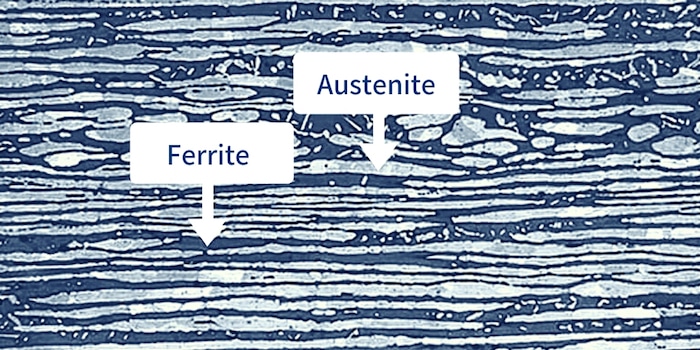 Why is it called "duplex"?
 Because it contains two phases—austenite and ferrite—with different crystal structures and properties—that coexist stably and evenly within a unified alloy system.
The core advantage of this "duplex" structure is its combined strengths and complementary properties:
The ferrite phase provides high strength and stress corrosion resistance.
The austenite phase provides high toughness and excellent weldability.
Ultimately, duplex stainless steel achieves the “1+1 > 2” effect, with a yield strength twice that of ordinary austenitic stainless steel while also offering excellent corrosion resistance, especially in harsh chloride-containing environments.


