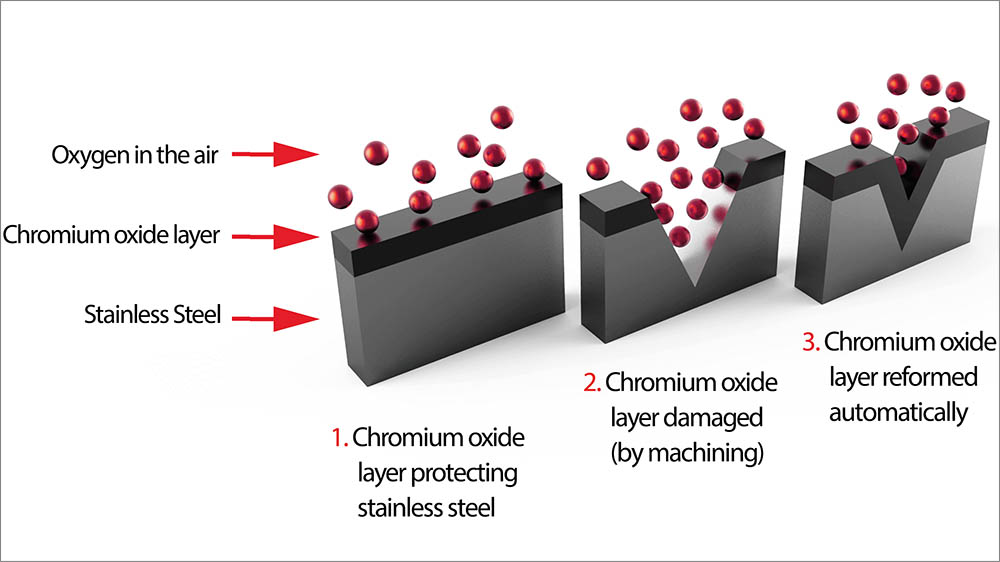
The reason why stainless steel "does not rust" can be attributed to one key word: self-protection. It is not that it will not oxidize at all, but that it uses a clever way to make its own oxide become a perfect layer of "armor".
National standards stipulate that the chromium content of stainless steel must be at least 10.5%, so the biggest difference between stainless steel and ordinary steel is that stainless steel contains a very high proportion of chromium.
When stainless steel is exposed to air, the chromium atoms on the surface react with oxygen to form an extremely thin, dense, and invisible chromium oxide film on the surface. This film is called a "passivation film", which prevents the internal metal from further reacting with air and moisture.
 Characteristics of a Passivation Film:
 Ordinary steel rusts because iron reacts with oxygen and water to form a loose layer of rust. This layer of rust cannot prevent further corrosion of the metal underneath, so the rust continues to spread.
The chromium oxide passivation film on the surface of stainless steel has three core characteristics that make it effective in preventing rust:
The passive film has an extremely dense structure, measuring only approximately 0.00001 mm thick, yet it acts like a "transparent protective film," completely isolating the iron inside from oxygen and moisture.
Chromium oxide is chemically stable and does not react with water, air, or most weak acids and bases at room temperature, maintaining its integrity for extended periods.
If the passive film is damaged by minor scratches or collisions, the chromium in the stainless steel will rapidly react with oxygen in the surrounding area (such as when exposed to air), regenerating a new passive film at the damaged area to continue its protective function.
A vivid metaphor:Rusting ordinary steel is like peeling an onion, peeling off layer by layer until you get to the core.
Passivating stainless steel is like peeling an apple and quickly applying plastic wrap to prevent further oxidation and discoloration.


